






Compare Punjabi Restaurant Experiences Before You Order
A side-by-side guide to choosing the right meal format
Short answer. The right Punjabi restaurant experience depends on the meal you want: a focused signature dish, a varied shared table, a first-time exploration or a coordinated group occasion. Compare each option on menu breadth, decision effort, dining pace, dietary questions and logistics. Verify the current menu and operating details directly; a restaurant’s concept alone cannot confirm availability, ingredients or suitability for a specific diner.

Choose the experience by the meal mission, menu breadth, group needs and questions that matter before ordering.
Name the meal mission before searching for the best restaurant
“Best Punjabi restaurant” sounds like one question, but it hides several different decisions. A quick lunch for one person has different success criteria from a family dinner. Someone who already knows the dish they want needs less menu breadth than a guest exploring Punjabi food for the first time. A birthday table adds timing and coordination that do not matter to a simple pickup.
Write one sentence before comparing options: “We want a focused meal built around one preparation,” “Four people want to share several textures,” “Two newcomers want guidance without ordering too much,” or “A group needs a confirmed plan and dietary answers.” That sentence becomes the comparison boundary.
Taste of Amritsar’s current homepage presents an Amritsari Punjabi concept in Brampton. However, the live page also displays unrelated template material and inconsistent contact information. This guide therefore uses only a narrow, verifiable menu-category signal and treats operating, service and business details as confirmation gates.
Compare four Punjabi restaurant experiences side by side

Use this article roadmap to review the key sections in order, then verify current details for your situation before acting.
| Experience | Who it fits | Selection strategy | Main trade-off |
|---|---|---|---|
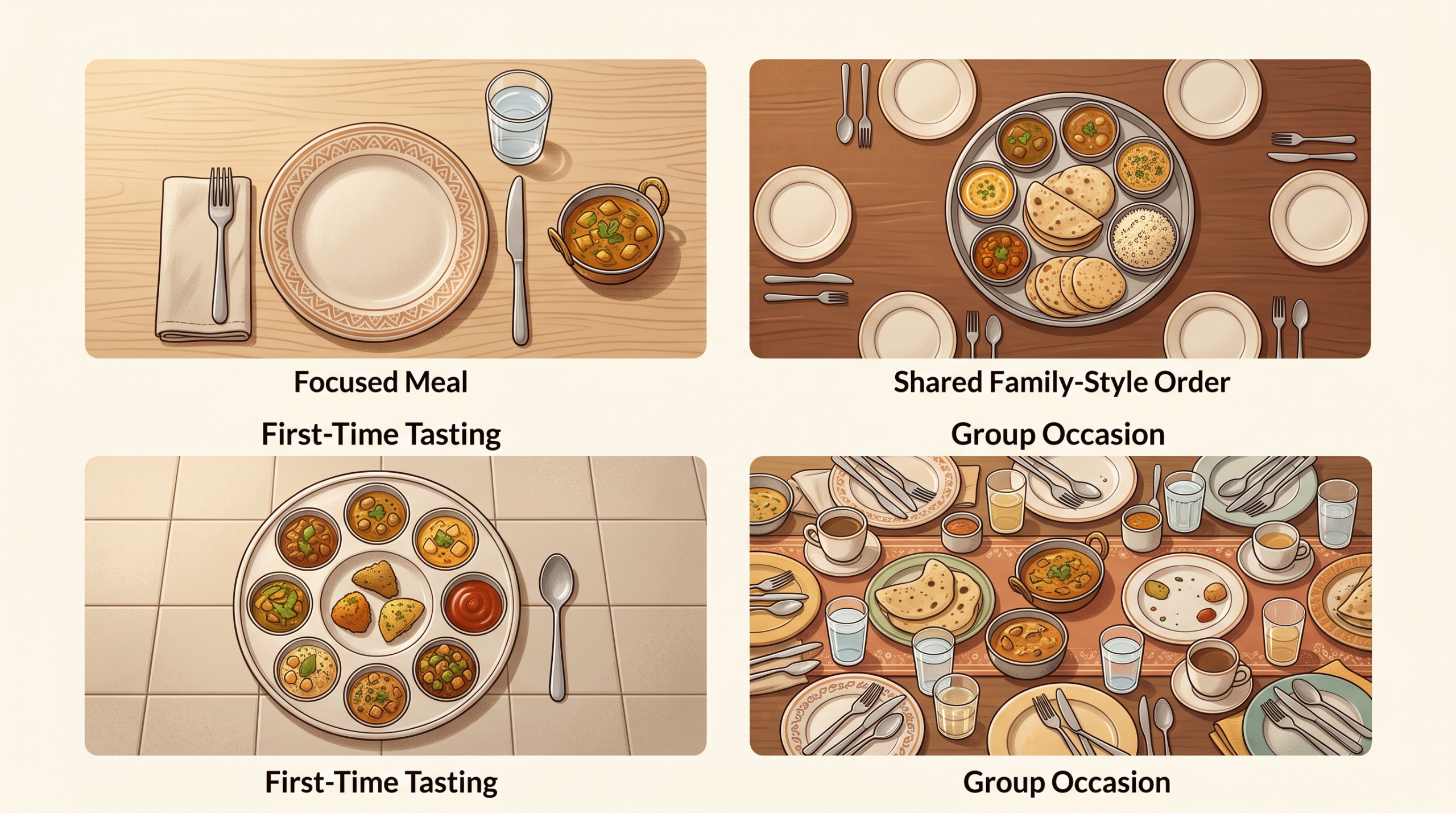
| Focused signature meal | A diner with a clear craving or limited decision time | Choose one anchor preparation and only the accompaniments needed to complete it | Efficient, but offers less variety and may not satisfy different preferences |
| Broad shared table | A small group comfortable sharing | Balance one or two anchors with contrasting vegetables, breads, sides and drinks | More discovery, but portion and overlap decisions become harder |
| First-time exploration | Newcomers who want context | Ask for a progression of textures and flavour profiles rather than the longest order | Requires staff guidance and clear dietary communication |
| Coordinated group occasion | A larger party or time-sensitive gathering | Confirm service format, quantities, timing, seating or pickup, and one order owner | Less spontaneity and more need for written confirmation |
These are not rankings. A restaurant can support more than one format, but not necessarily at every time or through every ordering channel. Confirm the specific experience instead of assuming that a broad menu guarantees group capacity or that a focused menu cannot support sharing.
Choose a focused meal when one preparation is the point
A focused visit works when the diner knows the desired experience and wants the restaurant to execute it without a large ordering exercise. The anchor might be a tandoor-baked bread with its traditional pairing, a curry-and-bread combination or a street-style plate. The selection principle is restraint: add only what improves balance or makes the portion workable.
Ask what arrives together, what is separate, how spicy the base preparation is, and whether accompaniments are included or ordered on their own. Do not assume two dishes with similar names have the same ingredients, richness or portion. Ask whether the item is currently available before travelling.
This path fits a solo diner, a quick meal or someone returning for a known preference. It is a weaker fit when several people have different dietary needs or everyone wants to sample broadly.
Plan a first Punjabi restaurant visit as a guided comparison
A newcomer does not need every category at once. Ask for two or three choices that show meaningful differences: perhaps tandoor versus griddle, dry versus sauced, or mild versus more assertively spiced. The goal is to learn what the diner likes, not to complete a survey of Punjabi cuisine in one sitting.
Describe preferences in ordinary language. “I enjoy smoky flavours but not much chilli heat” is more actionable than “Make it authentic.” Ask staff to explain what distinguishes the choices and what is traditionally eaten together, while recognizing that recipes and regional styles vary.
Taste of Amritsar’s current menu page publishes categories that include kulcha, tandoori snacks, curries, breads, rice dishes, tea, desserts and drinks. Use those categories to prepare questions. Because availability, prices, ingredients and page content can change, confirm the real order rather than relying on a saved screen.
Coordinate a group meal as a logistics project
A group occasion adds variables that taste alone cannot solve. Confirm the date, time, party size, dine-in or pickup format, one decision maker, dietary needs and how payment will work. Ask whether reservations or advance orders are accepted through a verified channel and what confirmation proves the arrangement.
For a pickup, ask about packaging, labelling, transport orientation, reheating or serving instructions and the pickup window. For dine-in, confirm seating, arrival expectations and whether the intended ordering format can be supported. Never infer private-room, catering, delivery or event capacity from generic “group” language.
Create a final order sheet with:
- confirmed item names and quantities;
- dietary questions and the restaurant’s exact response;
- included and separate accompaniments;
- price and applicable charges as confirmed that day;
- date, time, location and ordering channel;
- contact person and change deadline; and
- storage or serving instructions where relevant.
Ask dietary questions without relying on cuisine labels
“Vegetarian,” “mild,” “contains no nuts” and “gluten-free” answer different questions. Ask about the specific item, every component and cross-contact through fryers, grills, tandoors, utensils, storage and garnishes. Health Canada’s food-allergy information explains that reactions can be serious; an affected diner should not rely on assumptions from a dish name.
Use a direct script: “The diner has an allergy to ____. Does this exact item contain it? Could it contact it through shared equipment or preparation? Has the recipe or supplier changed?” If staff cannot provide a sufficiently reliable answer, choose another option rather than negotiating the risk.
For local food-premises information, Peel Public Health provides food-safety resources. An inspection status is one useful signal, but it does not answer an individual’s ingredient question, rank taste or guarantee future conditions.
Punjabi restaurant comparison mistakes to avoid
- Calling one restaurant “best” without naming the meal mission
- Ordering several similar dishes and mistaking quantity for variety
- Assuming a cuisine or vegetarian label answers allergen questions
- Using old menu prices or availability as current facts
- Trusting a templated website’s contact and booking links without verification
- Planning a group meal without one order owner and written confirmation
- Confusing chilli heat, spice complexity and richness
- Choosing for a newcomer without asking what textures and flavours they already enjoy
Frequently asked questions
What should a first-time diner order at a Punjabi restaurant?
Choose a small comparison rather than a huge spread. Ask for two or three preparations that differ in cooking method, texture and flavour profile and that fit the diner’s dietary needs.
How many dishes should a group share?
There is no universal count. Start with party size, appetite, whether dishes are individual or shareable, included sides and the desire for leftovers. Ask the restaurant for current guidance.
Does mild mean a dish has few spices?
Not necessarily. Chilli heat and the number or complexity of spices are different. Describe the sensation you want and ask how the kitchen can accommodate it.
Can I trust every detail on a restaurant website?
Use the site for discovery, then verify time-sensitive details. Inconsistent names, template products or placeholder contact information are strong reasons to confirm through a reliable current channel.
Plan the next Taste of Amritsar order carefully
Choose the meal mission, list diners and dietary questions, then review the business’s published menu categories. Before visiting, booking or paying, request current confirmation of the restaurant identity, location, hours, selected items, prices and ordering method through a verified channel. Once the live site’s template content is corrected, this comparison can link directly to a dependable contact or reservation path.


Leave A Comment